
The Mwekera Project covers a 7.5km mineralised belt surrounding the existing Mwekera mine and includes zones similar to the Frontier Copper Mine in the DRC (~85,000 tonnes of copper annually)
The Mwekera Project occupies ground situated to the east of the Kafue anticline and lies along strike of the well-known Mufulira, Frontier, Bwana Mkubwa (8.6 million tonnes at 3.34%Cu) and Lonshi copper (1.8 million tonnes at 7.2%Cu) deposits. Along this same trend, there are several other lesser known copper deposits identified in the past and still yet to be exploited, including:
- The Kasaria-Luansobe (21.5 million tonnes at 2.51%TCu Freeman, 1988),
- The Nsato deposit (8.4 million tonnes at 1.61%Cu Freeman, 1988)
- TheMutundu North deposit (4.3 million tonnes at 1.44%Cu)
- The Itawa deposit (40 million tonnes at 0.76%Cu)
Based on historical data and USGS, Mwekera suggests a non-compliant resource of over 10Mt copper at 1.53%TCu.
The geology of the project supports large-scale extraction, backed by strong historical data and geochemical and geophysical surveys completed to date indicate significant copper mineralisation potential.
Results from work carried out by Beltz Mining to date align with historical data and reinforce confidence in the resource scale and quality. Beltz has identified two distinct target styles through Pole-Dipole Induced Polarisation (PDIP):
- Target Area 1 – Roan style: Three distinct chargeability anomalies identified: Zones A, B, and C
- Target Area 2 – Frontier style: Strong, well-defined chargeability anomaly identified in the NE quadrant (Zone C)
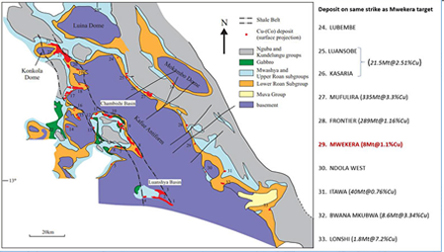
Apart from the Mwekera Project occurring in the known and proven mineral district, the Project has historical exploration records which add credence to the area’s prospectivity. Past drilling identified copper mineralisation at several stratigraphic horizons within the Katangan strata; with 3 main zones of economic copper defined within the Roan group of the Katanga supergroup. was estimated using 40 diamond cored boreholes. The copper resource is situated between 100 – 500 m below the surface.
The estimated resource comes from drilling data which covered only a 2.4 km portion of the Mwekera concession, out of the available 7 km of untested Lower Roan rocks. As such, Beltz believes there is excellent room and potential to expand the resource when the entire prospective ground is drill tested thoroughly.
Beltz plans to commence a 4000 – 5000m initial drilling program to identify mineralised zones.
The Mwekera Project is situated within the Lufilian Arc, a major Neoproterozoic geological structure extending across parts of Angola, the Democratic Republic of Congo, and Zambia. This region hosts the world-renowned Central African Copperbelt (CACB), home to significant copper and cobalt deposits. The project lies in the Domes Region, known for hosting world-class stratabound/stratiform sediment-hosted copper-cobalt deposits.
Mineralisation in the region is typically localised at redox boundaries between reduced and oxidised sedimentary layers, often controlled by structural features such as faults, anticlines, and synclines. The host rocks belong to the Katangan Supergroup, particularly the Roan Group, which includes continental red beds and overlying carbonates, followed by marine siliciclastics and volcanic units of the Mwashia Group.
There are varying theories on the origin of the metals, including:
- Epigenetic models, suggesting metals were introduced by circulating hot fluids during rifting.
- Syngenetic models, proposing metals were deposited with sediments derived from basement erosion.
- The most widely accepted theory is the diagenetic model, where sulphides formed from chemical reactions between pore fluids and host rocks during sediment diagenesis.
Overall, the Mwekera Project is strategically positioned in one of the most metal enriched provinces globally, with geology and structural features highly prospective for copper-cobalt mineralisation.
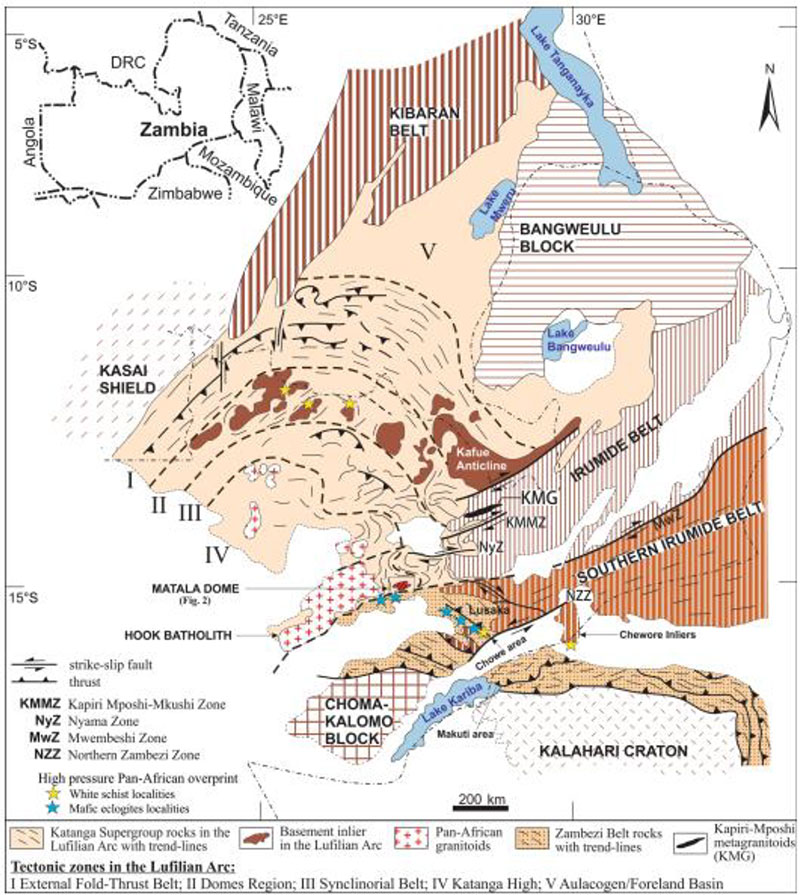
In the Copperbelt, these deposits are localised in intracontinental rift basins which culminated from extensional tectonics of the pre-existing paleoproterozoic basement with subsequent crustal shortening of the basin-fill during the Pan-African orogenic event. The basin fill are collectively referred to as Katangan supergroup sediments which are further subdivided into the Roan Group (Lower and Upper), Mwashia and Nguba. The basal Roan Group consists of early-rift stage continental siliciclastic “red beds” (Lower Roan) underlying evaporitic carbonates and siliciclastic rocks (Upper Roan) which in turn are overlaid by marine siliciclastics and mafic igneous rocks of the Mwashia Group.Copper mineralisation occur in multiple lithologies and stratigraphic positions and vary in type of mineralisation and alteration, but share vital characteristics. Deposits occur at the lowest redox boundary within reduced facies rocks above oxidised facies rocks. This redox boundary may be stratigraphically or structurally controlled, consequently is positioned at different levels throughout the CACB. Many deposits are positioned in the vicinity of macro-structural features, primary growth faults and large anticlines and synclines formed during Lufilian inversion of such faults.
Source of metals in the Katangan basin is generally thought to come from the basement but ideas on how and when they got to present deposition sites abound. Some scholars postulated metal source to be from convective recirculation of hot basinal fluids driven by high geothermal gradients associated with crustal rifting in the Lufilian (epigenetic model). Many others believe metals were derived from erosion of basement with sediments transported in rivers and adsorbed on clays and deposited contemporaneous with host rocks (Syngenetic model).
The widely accepted genetic models are the early, intermediate to late diagenetic models which developed from studies of diagenetic processes in sedimentary rocks (Brems et al., 2009; Sillitoe et al., 2017; Sweeney and Binda, 1989). These models contend that sulphides were precipitated during large-scale chemical reaction of host rock and its pore fluid with metalliferous brine (Bartholome et al., 1971; Annels, 1984; Selley et al., 2005; Unrug, 1988). Copper and its accompanying cobalt or silver were introduced during diagenesis of the host sediments (Brown, 1997; Hitzman et al., 2005).
